They wrote the book on federal resumes.
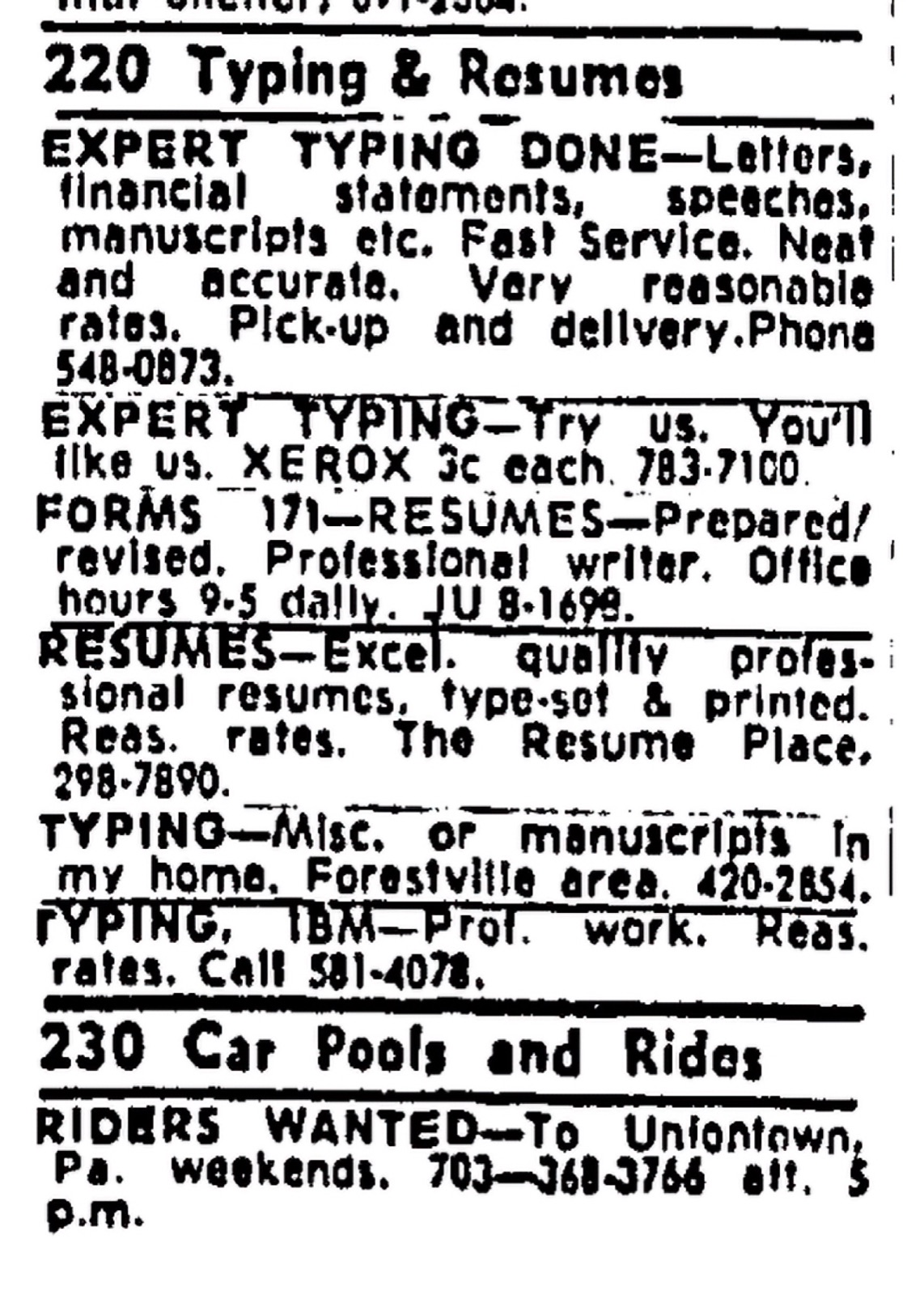
In 1972, before there was a USAJOBS.gov, before there was a federal resume as a category, Resume Place placed its first ad in the Washington Post classifieds. "RESUMES. Excel. quality professional resumes, type-set & printed. The Resume Place. 298-7890." The studio was a print shop on K Street with storytellers on staff. People walked through the door with a job announcement and walked out with a federal resume.
Five decades later, Kathryn Troutman, who founded the business in 1971, still leads it. In 2024 Resume Place hired us to design the system that carries that history forward: a complete identity, the program marks behind the Ten Steps curriculum and its certifications, a rebuilt site, and a campaign program tied to the federal-news cycle. The brand carries fifty years of Washington-rule changes as a working credential.
Strategy
Fifty years of authority, no system to hold it.
Resume Place writes federal resumes, publishes the Ten Steps to a Federal Job® curriculum, certifies trainers, and trains federal agencies. Each line arrived in a different decade and built its own materials, so the company looked like several companies, and none of them carried the fifty years of authority that is the actual asset.
The brief: an identity worthy of the original, a mark system for the programs the business actually runs on, a site a customer can navigate by business line, and a production rhythm that answers federal news as it breaks.
Audience
Three doors, three buyers, one company behind them.
- 01
The job seeker
A federal applicant, a fed carrying a decade of accomplishments into the private market, or a senior leader facing ECQs, the executive-qualification essays OPM requires. Arrives alone, at a high-stakes moment, and decides in minutes whether these people have done this before.
- 02
The federal agency
A contracting officer or workforce-development lead buying ECQ workshops and curriculum on a government rate and a government timeline. Needs capability statements, a GSA schedule, and receipts that survive a compliance review.
- 03
The certified trainer
An educator who earned the credential and teaches the method in transition offices and resource centers. Both the audience and the brand’s extension into the field, carrying its marks onto rooms and websites Resume Place does not control.
One visual language had to hold all three without changing how the company looks for each one.
The classifieds
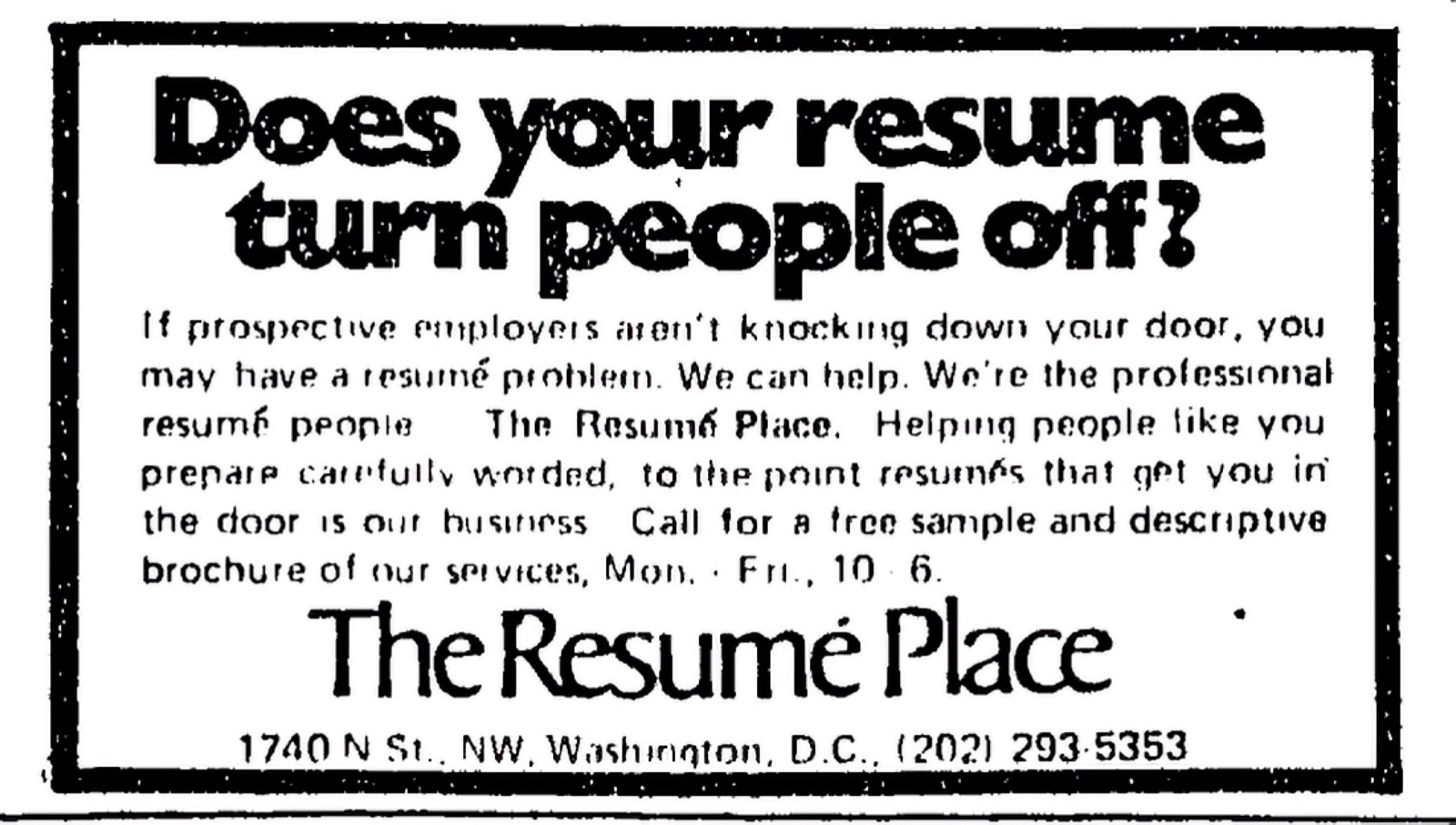
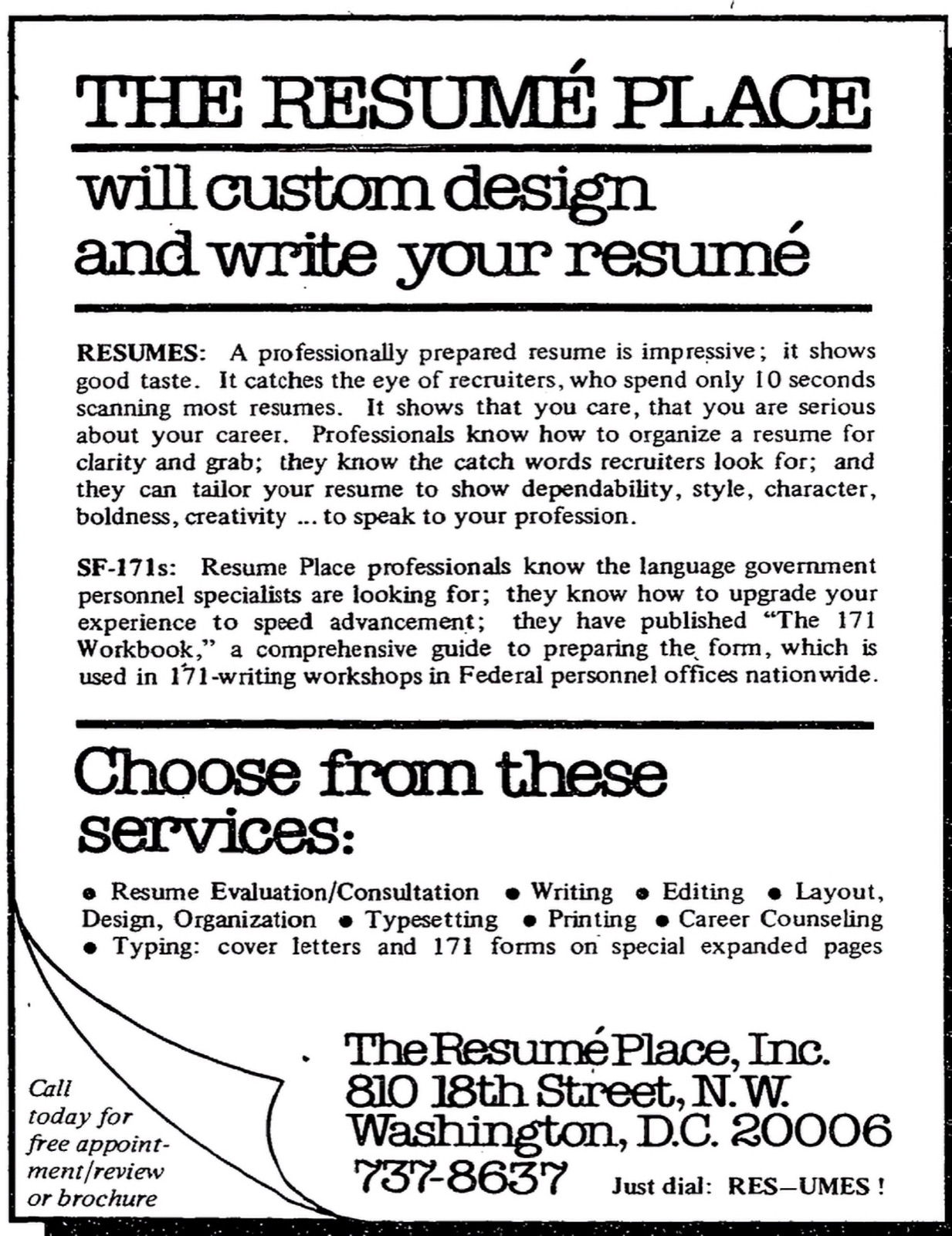
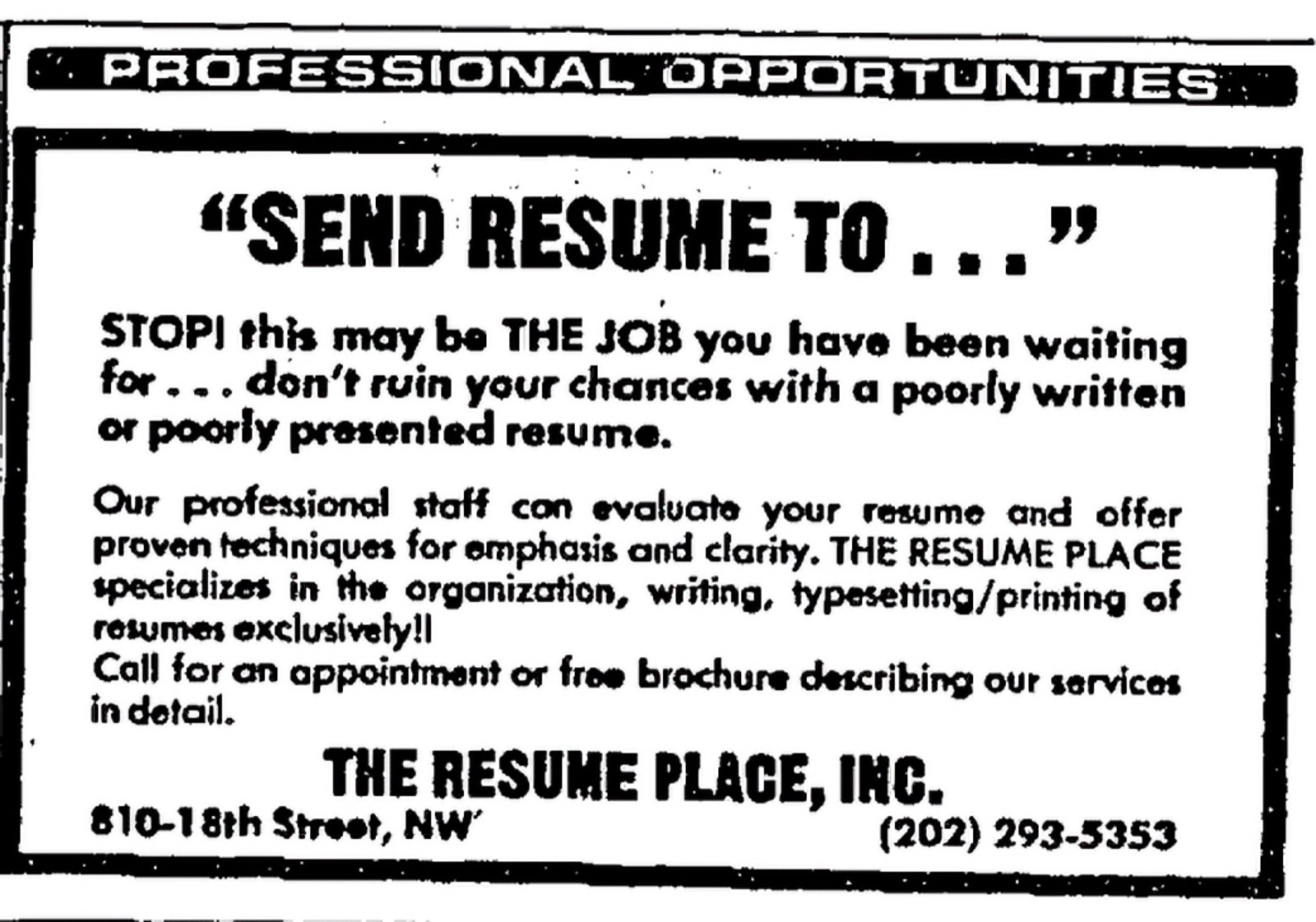
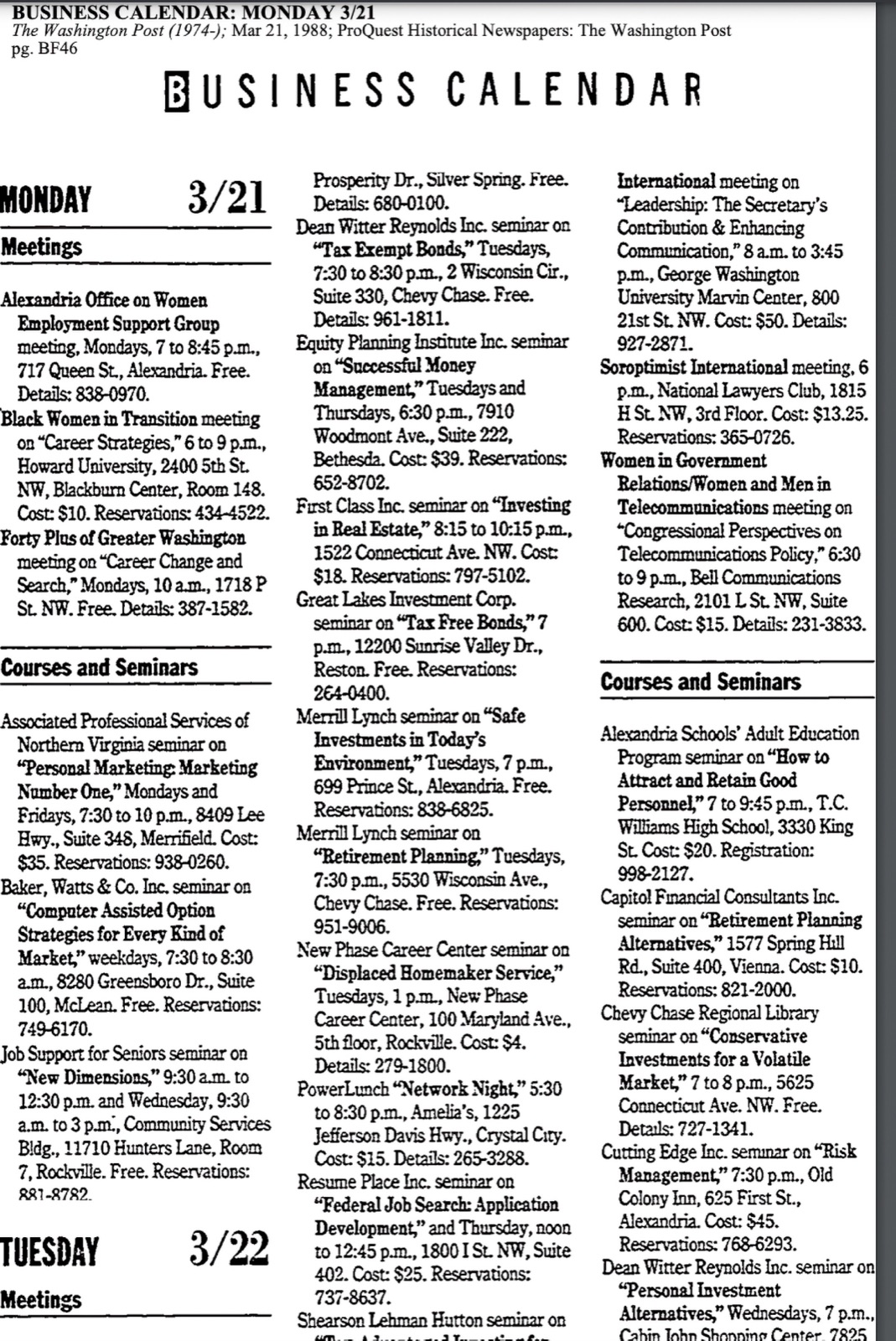
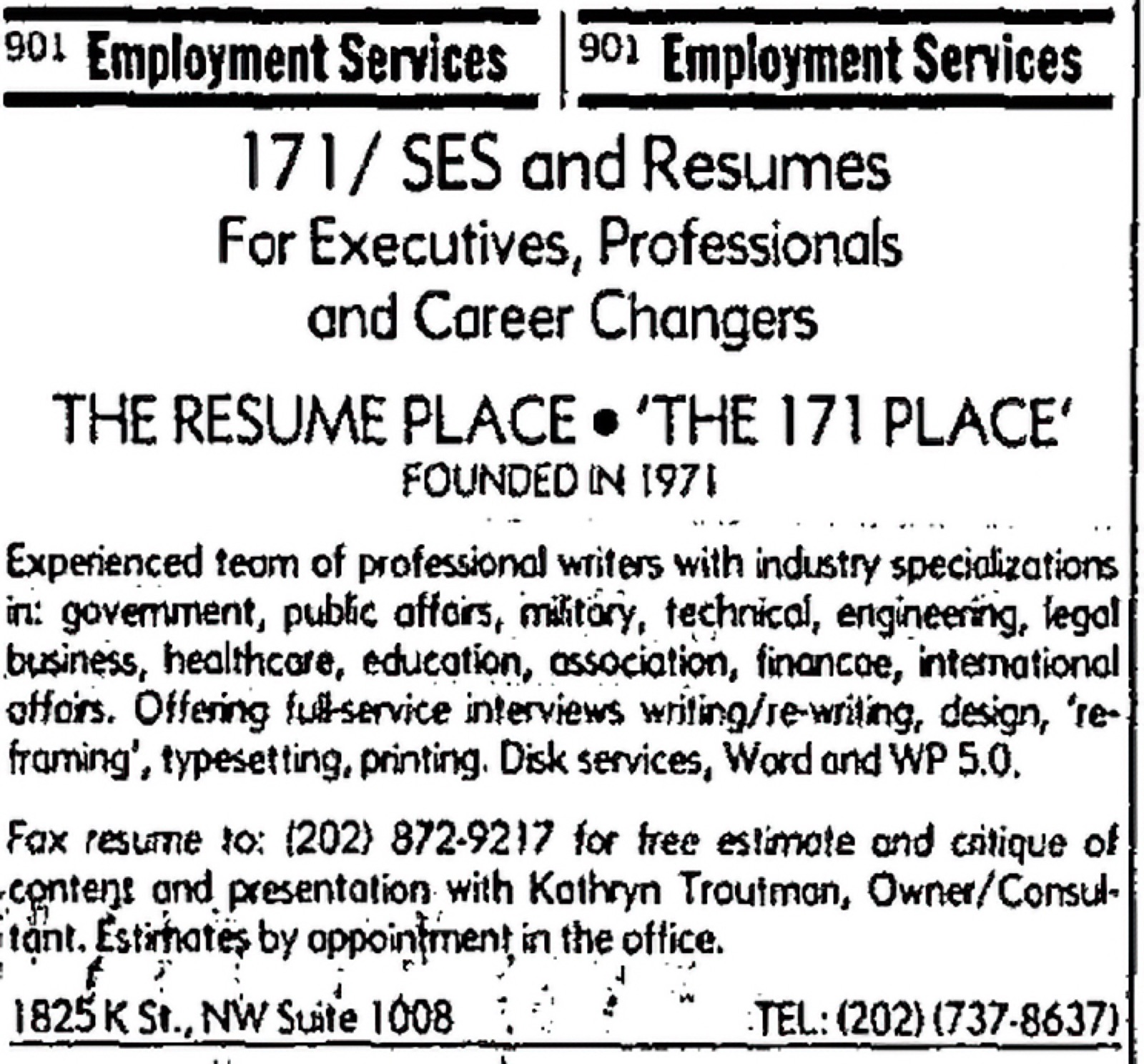
Twenty years of Washington Post ads read as the company becoming itself: one line in the typing column in 1972, a display ad by 1974, the SF-171 specialty by 1981, a listed seminar by 1988, SES leading by 1993 with Kathryn Troutman signing as owner.
We read this archive before drawing anything. The order of the business in 2024, resumes into curriculum into training, is the order the classifieds established fifty years earlier.
Washington Post, 1972 to 1993
Six clippings, one arc.
These are Resume Place’s own materials from before we were hired. Each is shown whole, at its original size and shape, the way it ran.
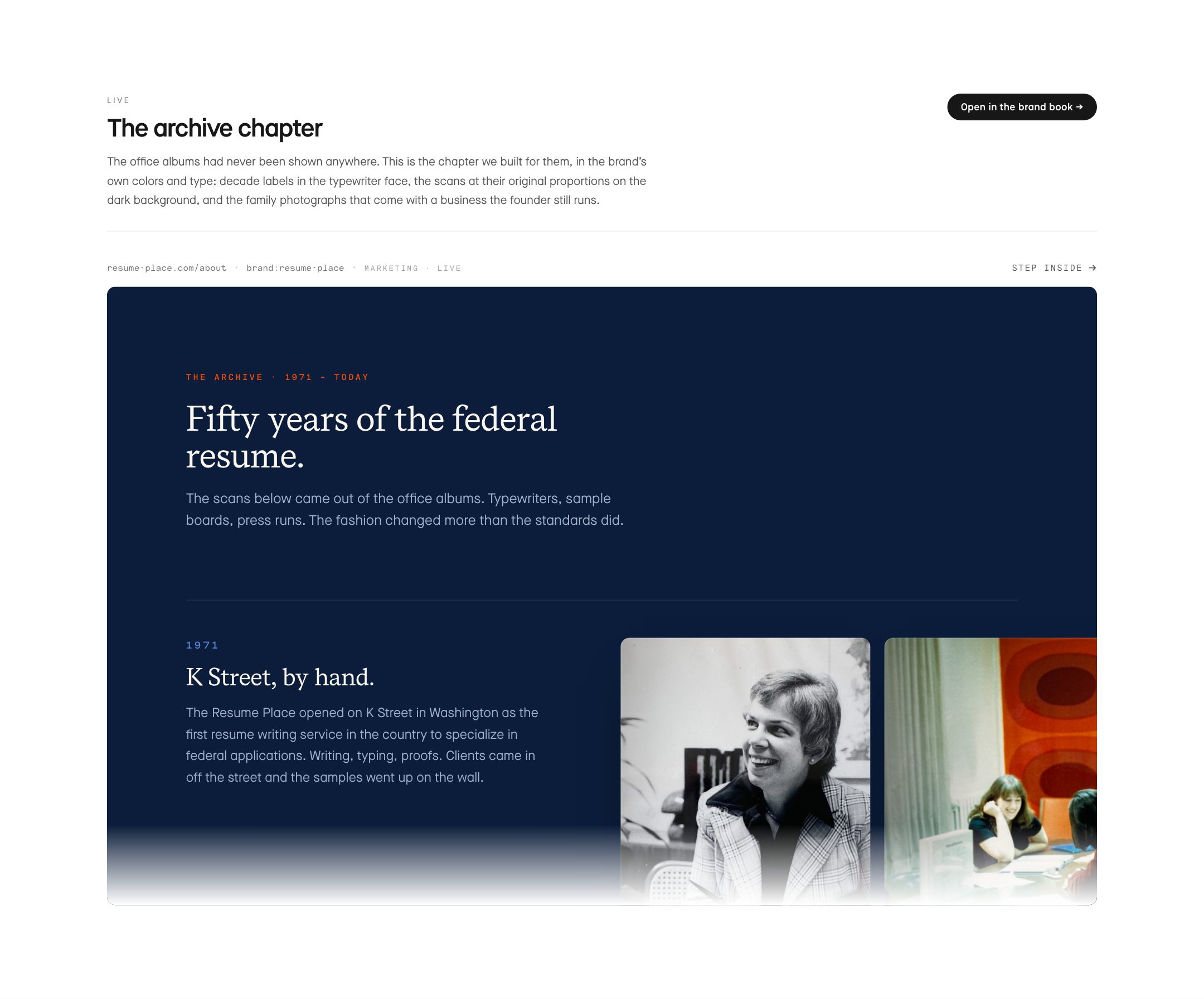
Architecture
Name every line of business.
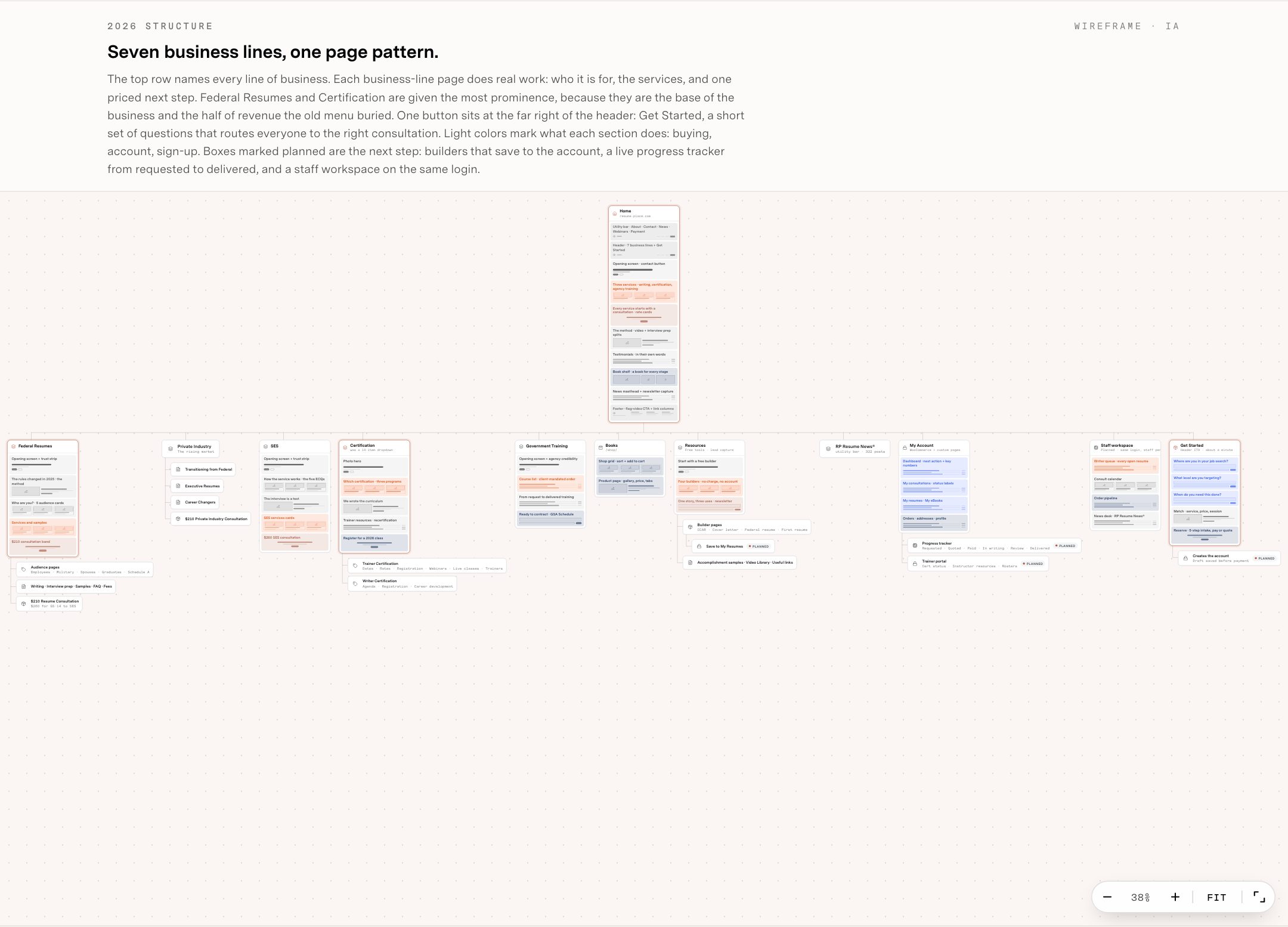
The site had accumulated the way twenty-year-old sites do: one-off links in the top menu that belonged to no section, a fourteen-item certification dropdown, the same links repeated across three menus. The founder set the constraint that fixed it, and she was right: every line of business is named at the top level, in descriptive words. Certification and government training are half of revenue. Each line has its own customer who arrives looking for that exact term.
Seven business lines and one call to action. Every section follows the same order: who we help, then services, then one priced next step. And nothing was lost. All sixty-five destinations in the production menu stayed reachable; we reorganized them. A structure that protects the search rankings fifty years of content earned.
UX
Reductions in force changed who walks in the door.
When we started in 2024, the typical customer was someone applying for a federal job. By 2026, reductions in force and reorganizations across the government had changed that. Two groups moved to the front: feds leaving for private-sector work, and senior executives. The federal applicant is still the steady base of the business. Agencies and trainers still matter, just less often, so they sit lower on the list.
Each profile names what someone came to do, and what it costs them if it goes wrong. No biographies.
Audience
Reductions in force put two new people at the front.
Priorities move with the federal-news cycle. The full set lives in the brand book at /brand/resume-place.
- 01
The Transitioning Federal Employee
Fed moving to the private sector · rising
A fed facing a reduction in force, or one who does not know yet whether the job is safe. A decade of real accomplishments in a resume built for USAJOBS, not for a recruiter who reads it in six seconds.
- 02
The Senior Executive
SES candidate or senior leader · rising
Applying to the Senior Executive Service or carrying executive-level experience into the private sector. ECQs, the five-page narrative, the two-page executive resume. Higher stakes, heavier documents.
- 03
The Career-Advancing Applicant
Federal seeker, GS-7 through GS-15 · core
Real accomplishments and no clear way to fit them into a federal resume. OPM rules, GS levels, and a USAJOBS form that does not reward modesty. The base the whole business is built on.
- 04
The Agency Training Lead
Agency HR and workforce development
Buys ECQ workshops, trainer certifications, and curriculum on a government rate and a government timeline. Needs a partner who can show the receipts.
- 05
The Certified Trainer-Coach
Ten Steps certified educator
Teaches the federal job search using the Ten Steps curriculum in resource centers, transition offices, and private practice. Both the audience and the brand’s extension into the field.
A form that never loses a lead.
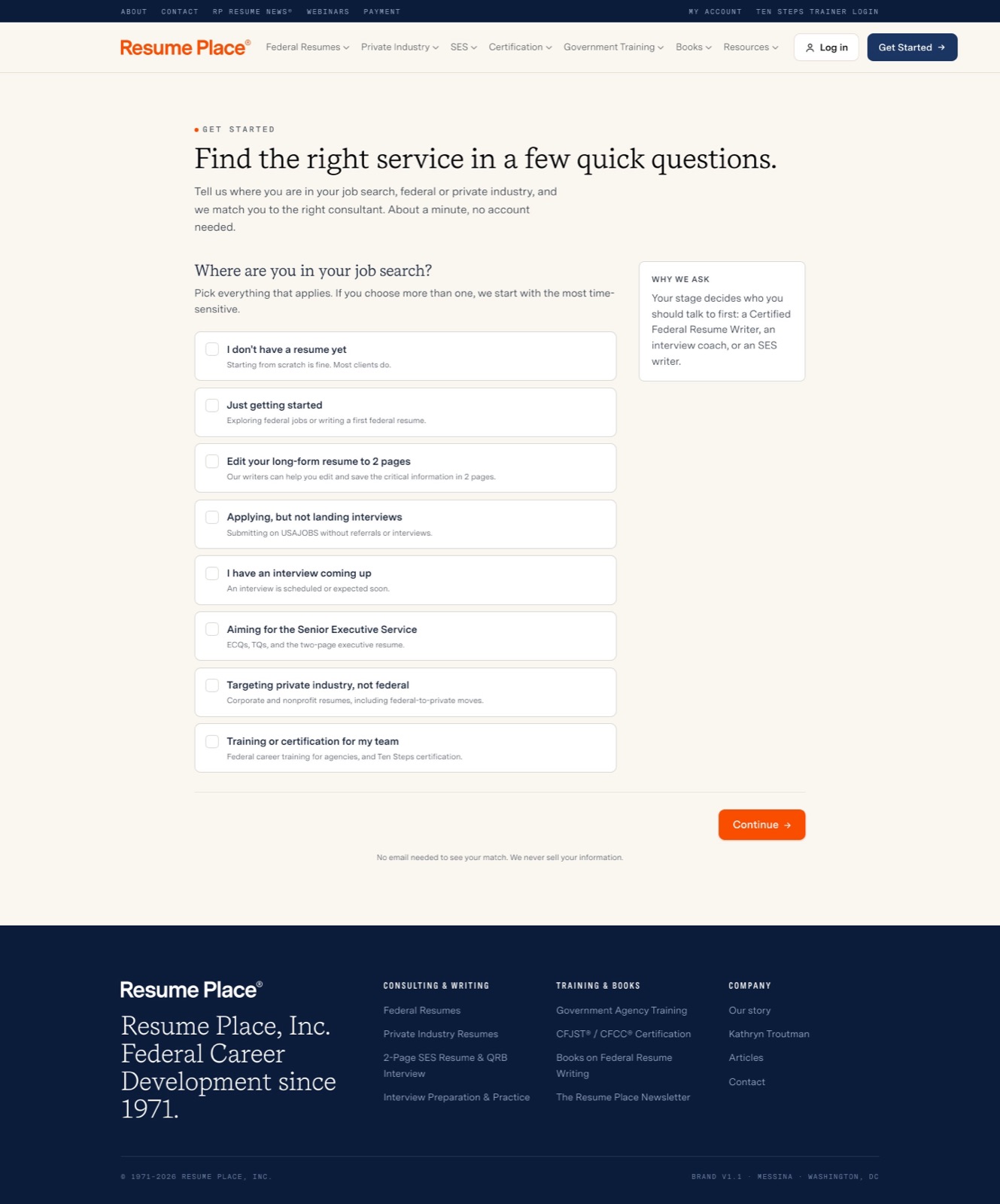
The consultation form is where the site turns visitors into clients: five steps, ending in a choice. Pay now and go straight to checkout, or ask for a quote and keep a payment link that holds the reservation until the client is ready. Both paths follow the same rules, and we tested every one of them end to end before the new site went live, every email included.
User flows
The four rules.
- 01
Nothing is ever lost
Every form stores a private record before any email is attempted. A mail failure never loses a lead.
- 02
One priced entry per panel
Every business line ends in a single clear next step with a price on it: the $210 consultation, the $260 SES hour, the certification registration.
- 03
The quote path stays warm
A client who is not ready gets a private payment link in the confirmation. Staff can forward it; clicking it adds the exact service to their cart and keeps the record linked.
- 04
The account arrives at checkout
No sign-up required up front. The account is created at the first purchase, and earlier form submissions attach to it once the email is confirmed.
Identity
A mark that checks the box.
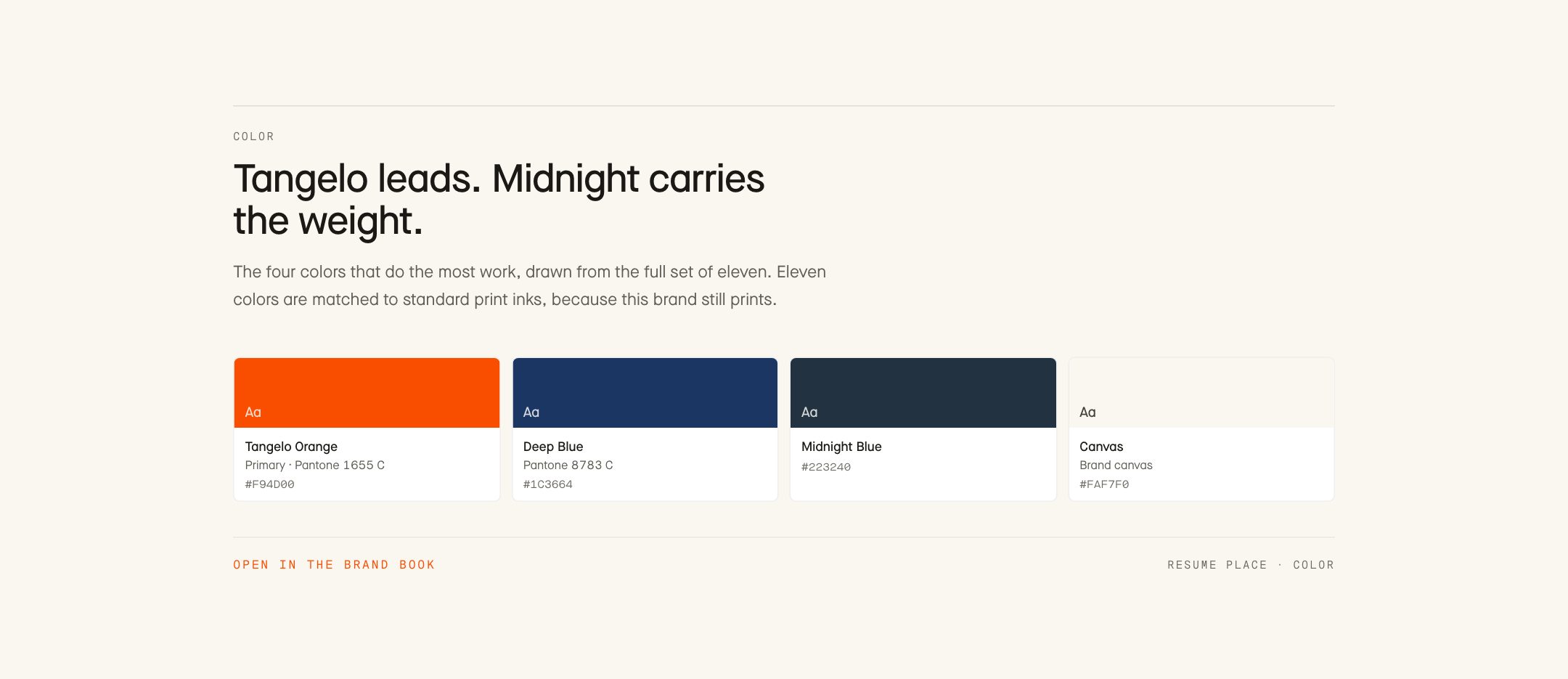
The company name, set as a logo, is the primary mark. The circle-checkmark symbol works as a separate shorthand: the box on the form, checked. It stands alone on banners, certificates, and the screens of the online tools, and it rarely pairs with the name. When both appear together, the approved combinations do that work.
How much empty room the logo needs is measured off the logo itself: the height of the R around the name, the gap inside the checkmark around the symbol. Rules a client can apply without calling us.
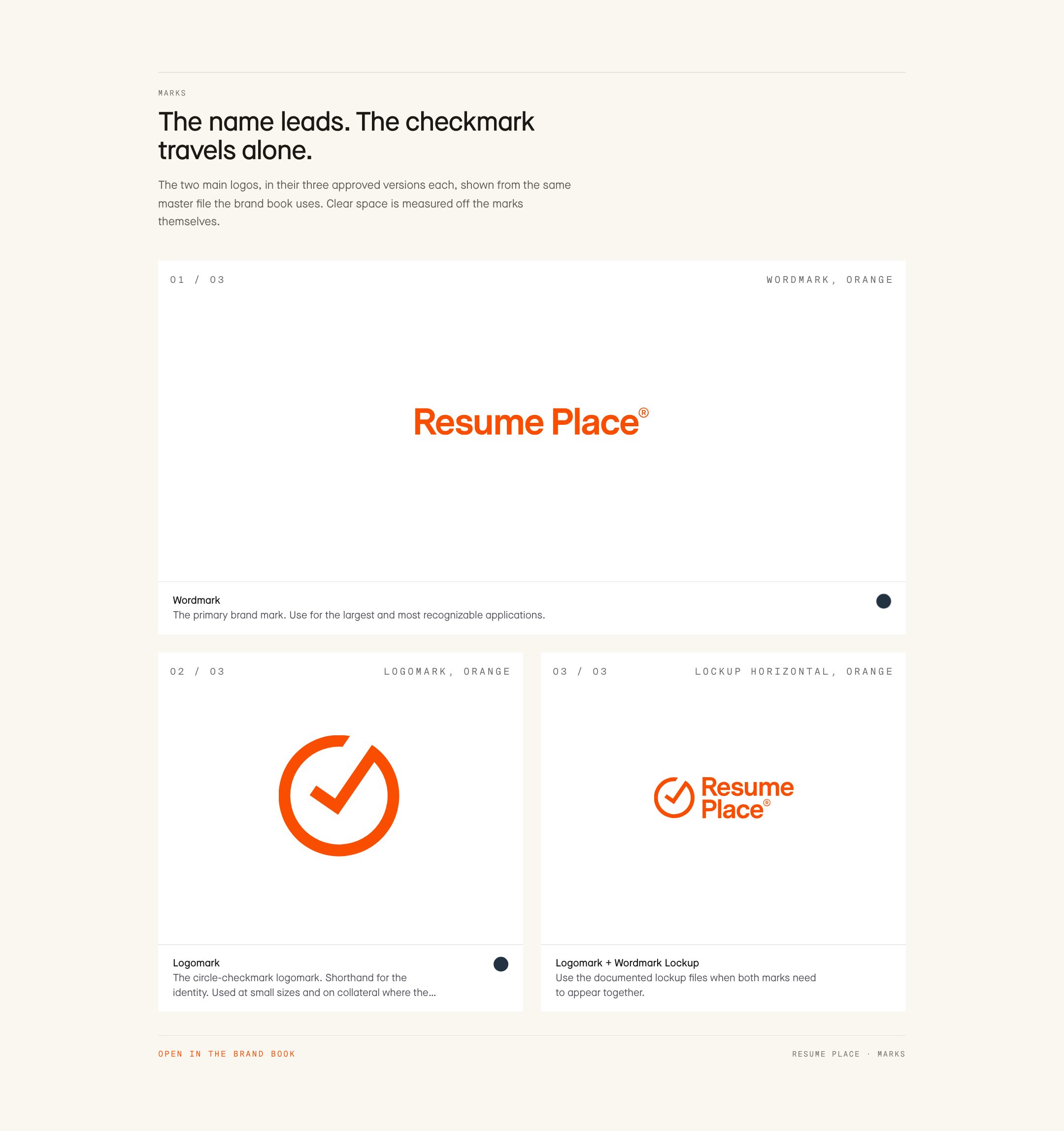
Warm colors for a serious business.
Fifty years of federal credibility needed institutional weight without reading like an agency itself. Tangelo Orange holds the recognition the brand already owned; the Deep and Midnight Blues carry the seriousness a government buyer expects. Eleven colors, each matched to a standard print ink, because this brand still prints: books, certificates, capability statements.
One family, drawn to work together.
Messina, from Lineto, is a complete family. The Sans does the everyday text and the Serif takes the magazine-style moments. Mono is there for the OPM and SES shorthand this audience reads daily. All three were drawn together, so they share the same proportions and the same underlying shapes and can sit on one page without clashing. A book interior and a web form never disagree about what a heading is.
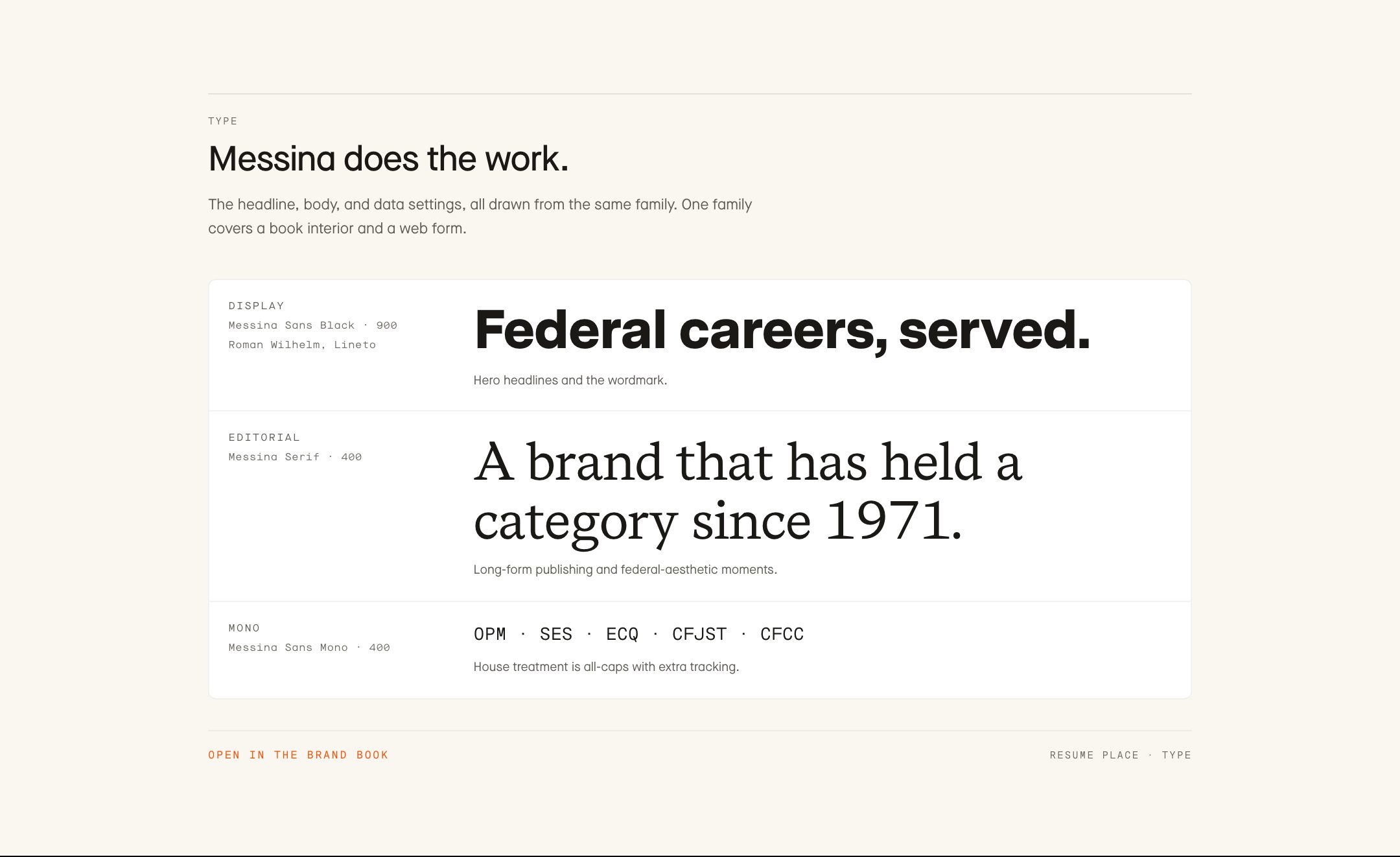
Cut-and-dried but certainly not dry or dull.
Programs
The curriculum is the front door.
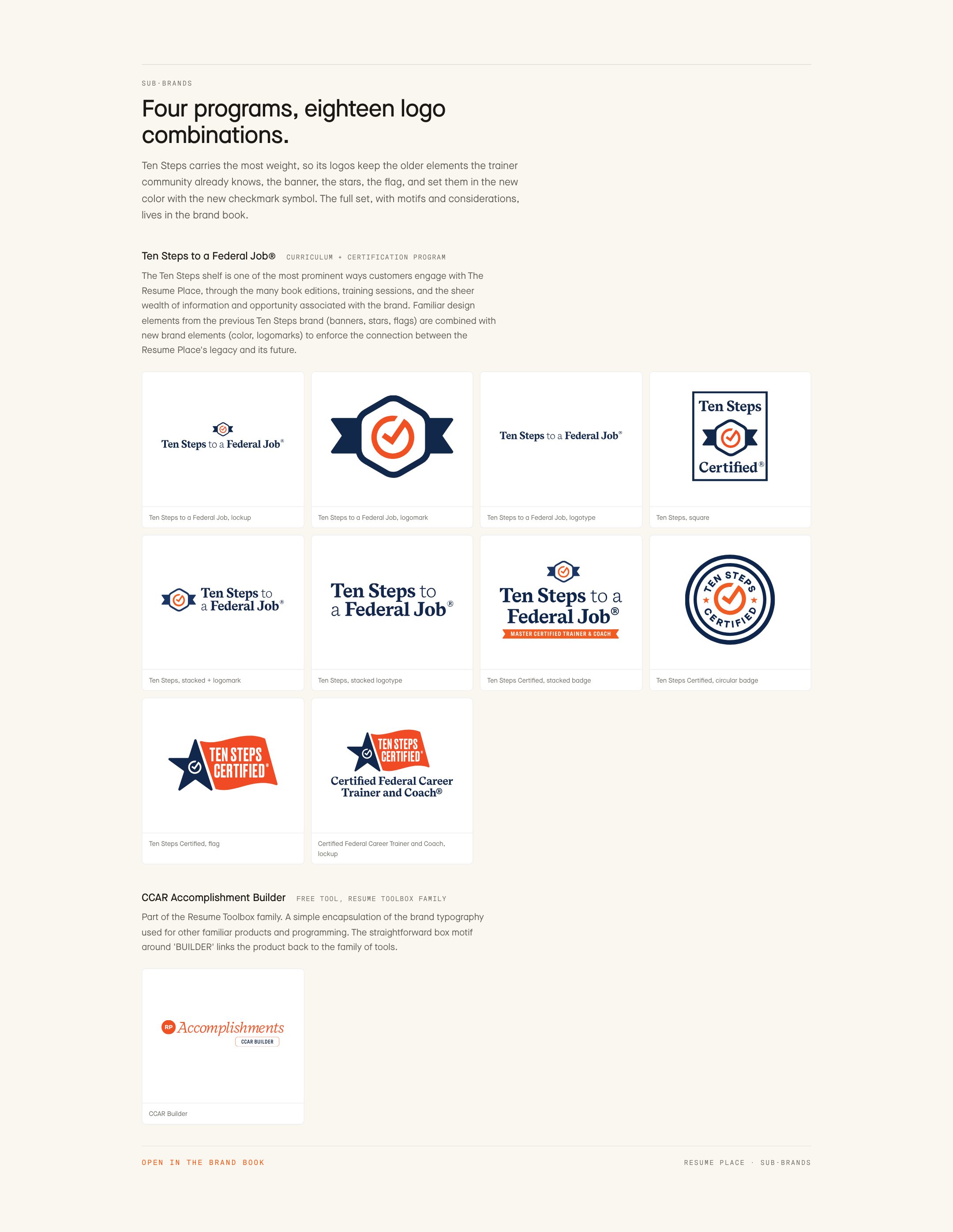
Most customers meet a program before they meet the company: a Ten Steps class, a trainer certification, a free builder. Each program needed a mark that can stand alone on a partner’s slide deck or a military transition office wall and still resolve to Resume Place up close. We drew eighteen approved logo combinations across four systems: Ten Steps to a Federal Job®, the CCAR Accomplishment Builder, the Executive Leadership Training Program, and Online Learning.
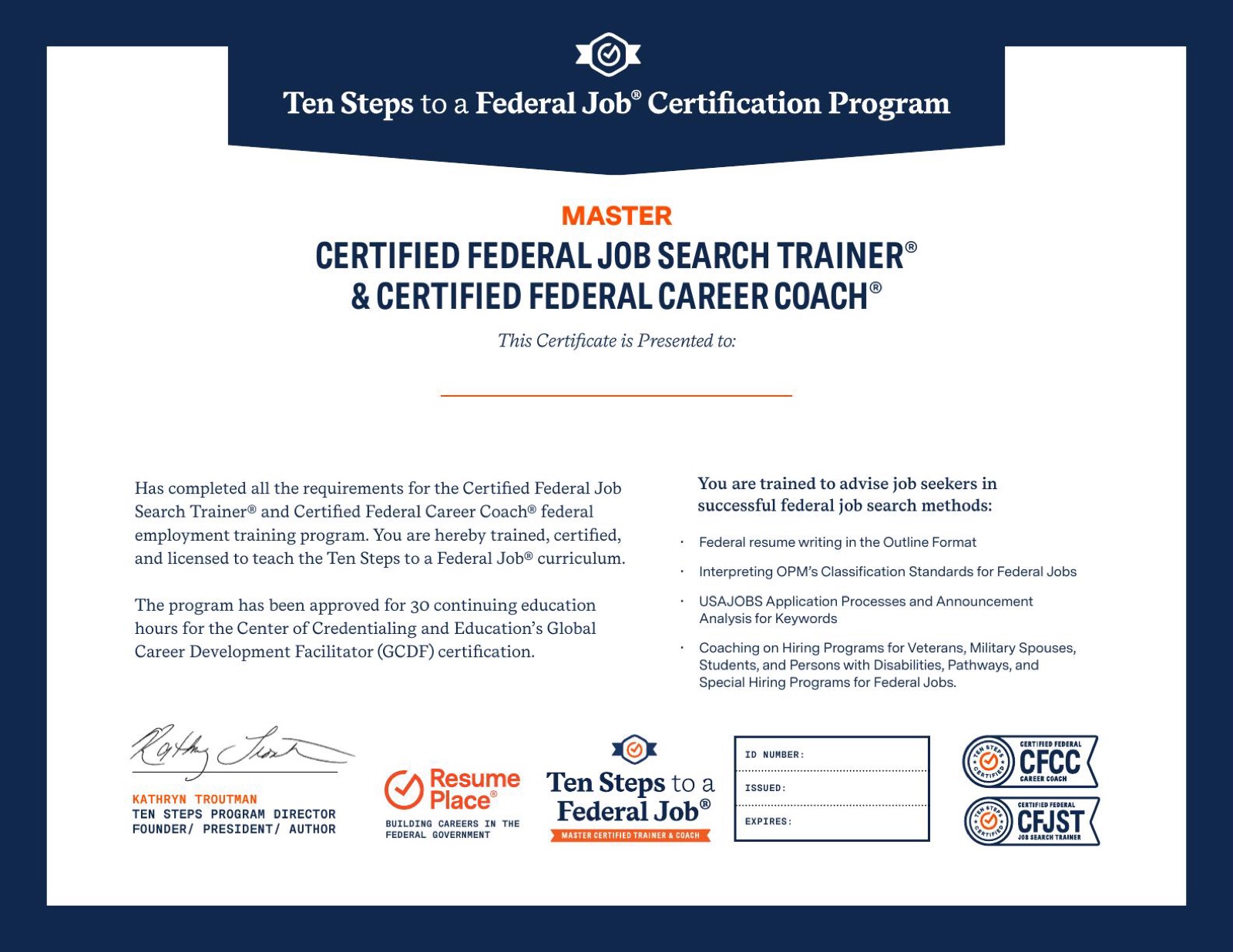
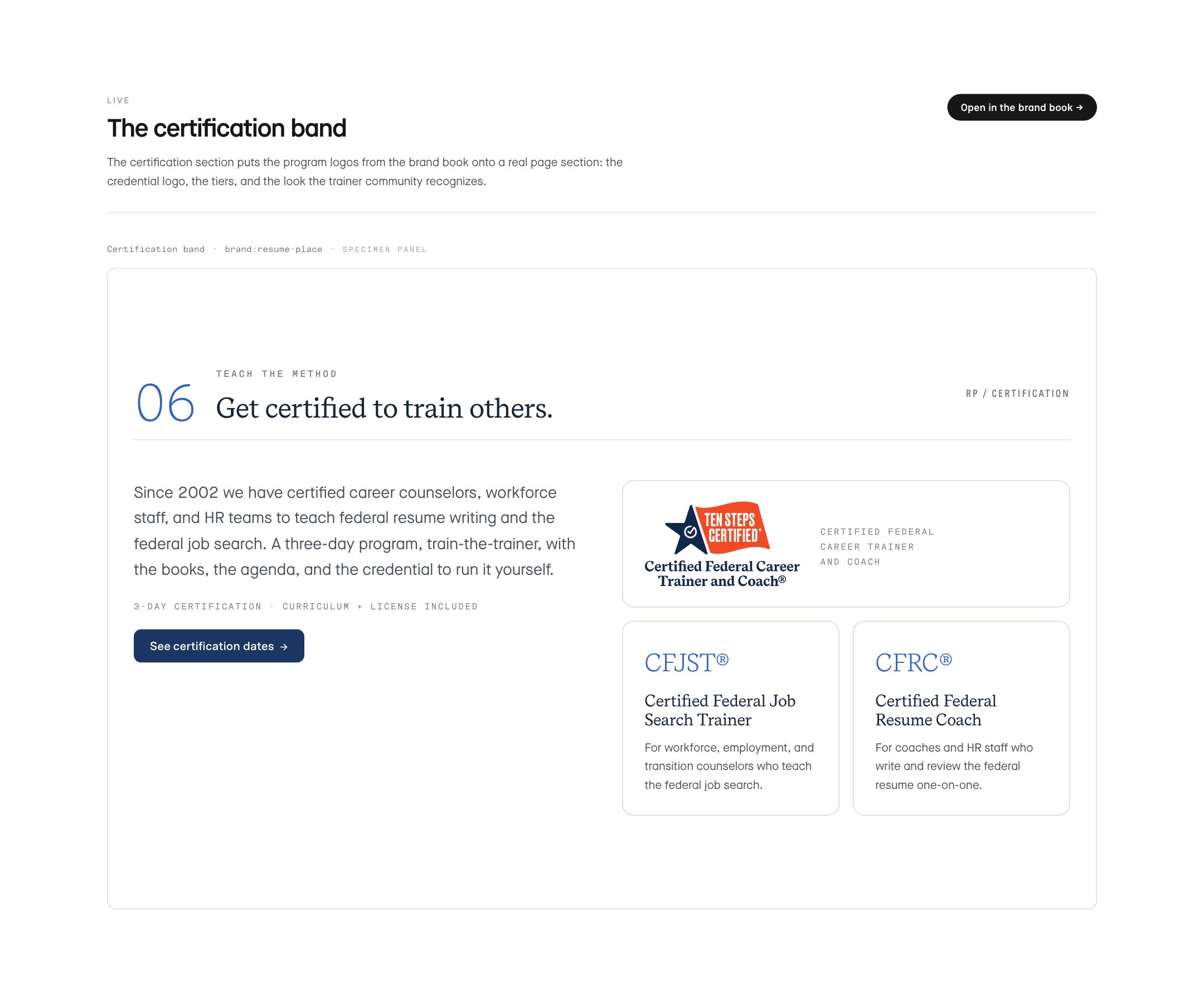
The certification badges came out of that same work: ornamental seals redrawn as clean, simple shapes, one tier for Certified Trainer & Coach, one for Master Certified. A trainer puts that badge on their own site, so it has to survive at the size of a browser-tab icon and still look earned.
System
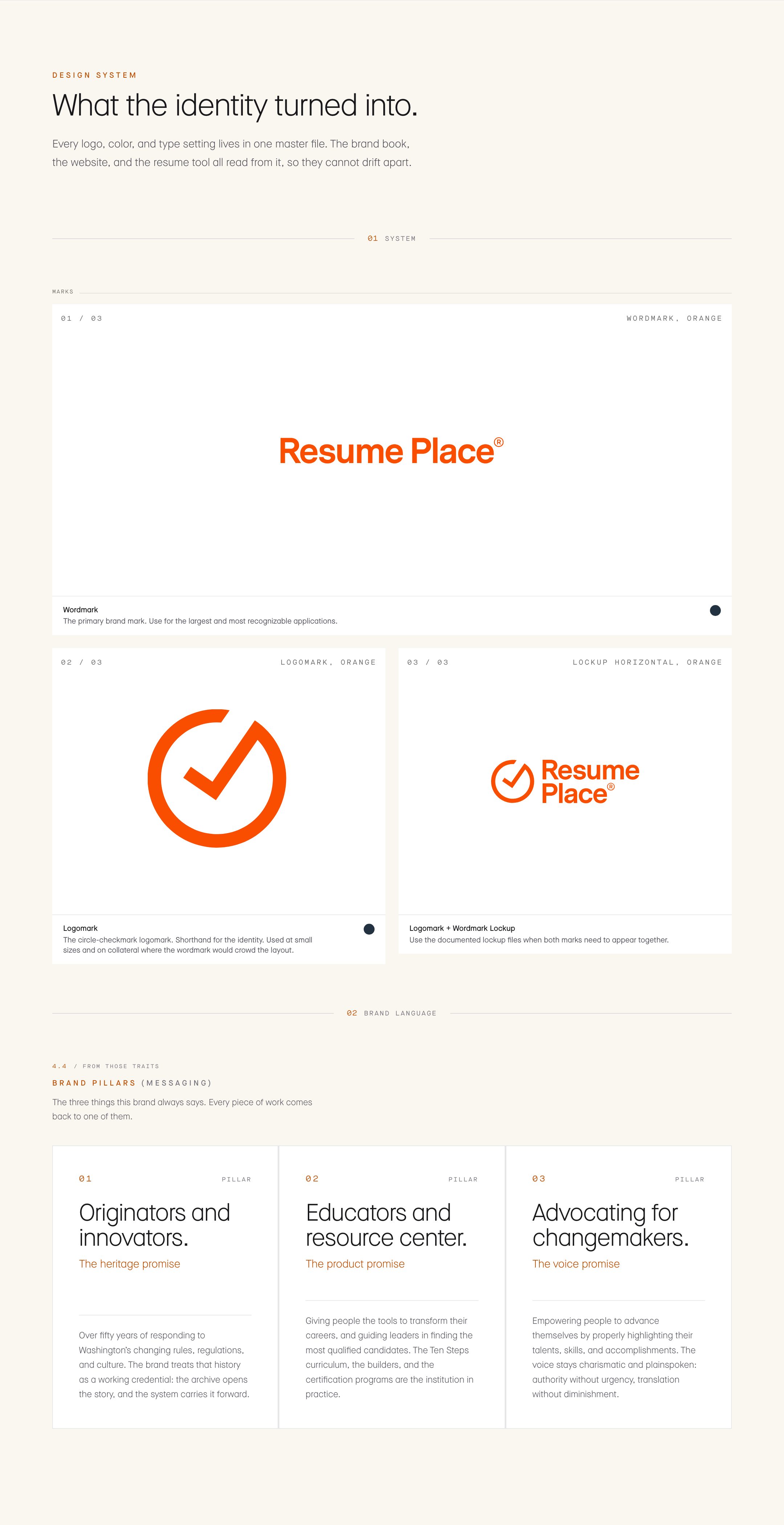
The brand book is a URL.
The v1.1 book was delivered in September 2024 and then kept living. Every change is tracked and dated the way software is, and the book updates the moment we change it. Alongside the human-readable book, the brand publishes a version AI tools can read directly, plus a ready-made set of instructions with banned and preferred words, so those tools can write on-brand copy without a designer reviewing every piece.
Federal news sets the publishing calendar.
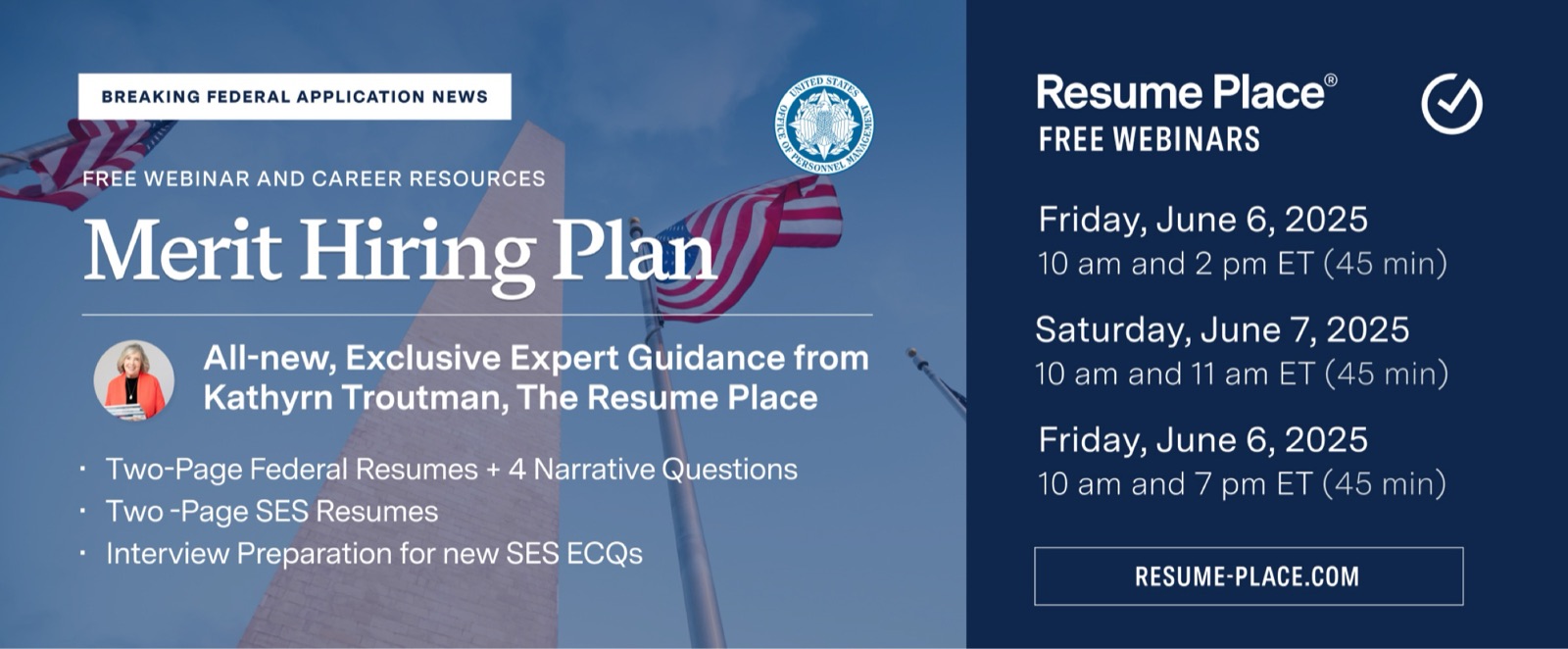
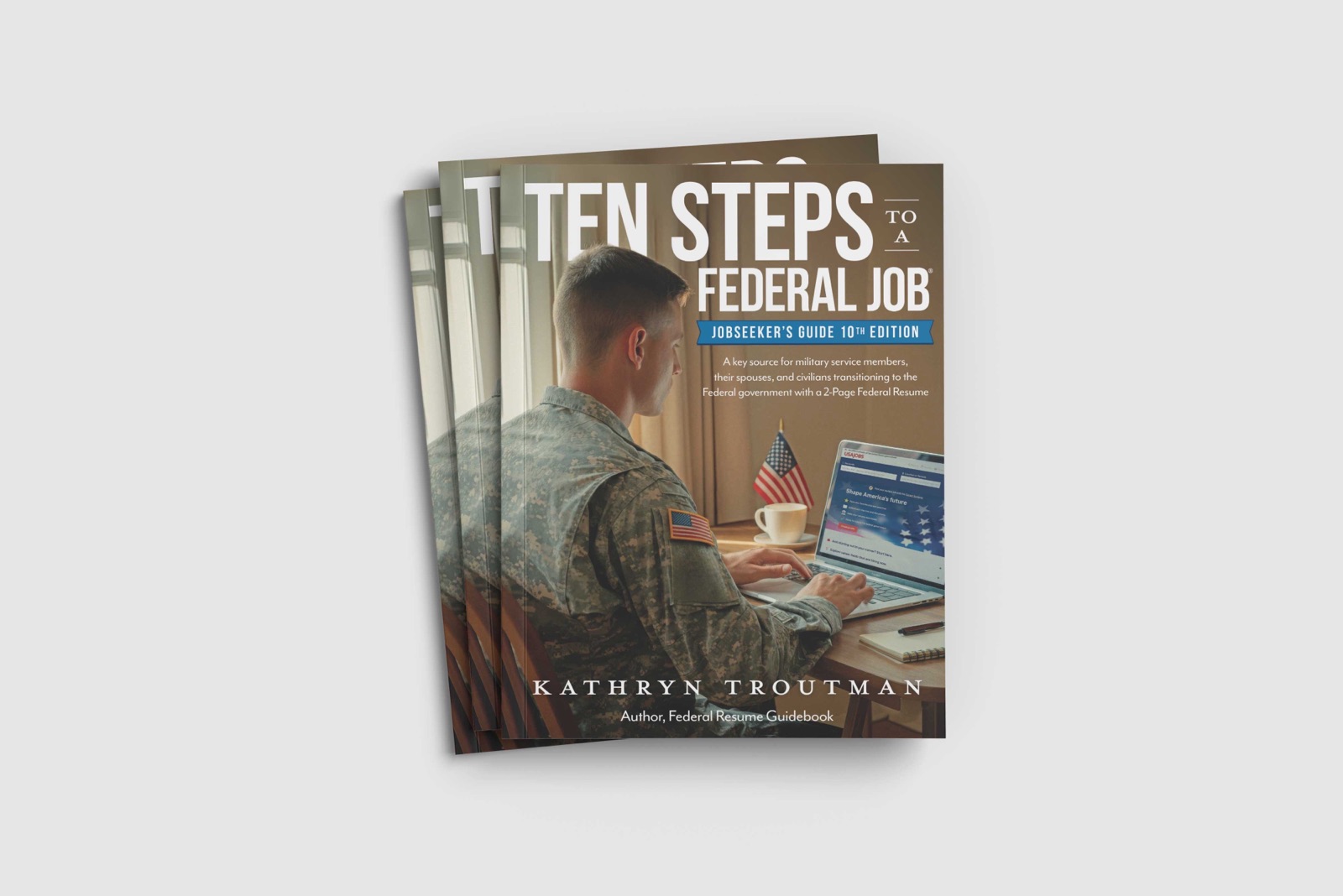
Federal hiring rules change, and the brand answers in kind: a banner program on a monthly cadence against OPM guidance and hiring-rule shifts, a newsletter, and the book covers, certificates, and presentation decks that carry the system into print.


Site
On screen, the orange whispers.
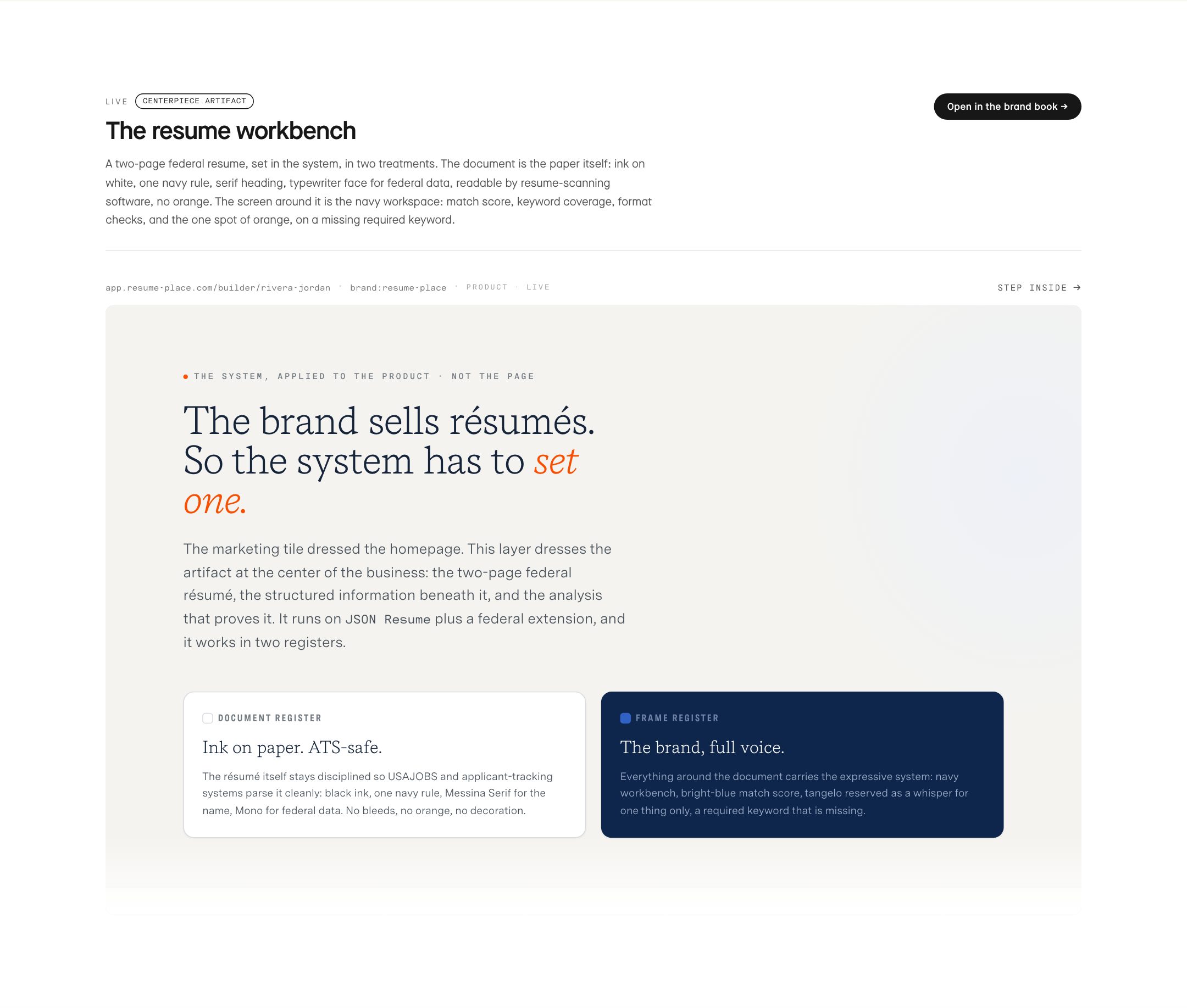
Print leads with Tangelo. Screens invert it. On screen the dark blues become the background, the book-cover blue does the work for links, page numbers, and whatever you are currently on, and the orange appears once per page: the main button. The same family does the structure, Messina Serif for headlines, narrow capitals for menus and labels, Mono for data only.
The sections below are built from the same master file the brand book reads.
Shipped 2026
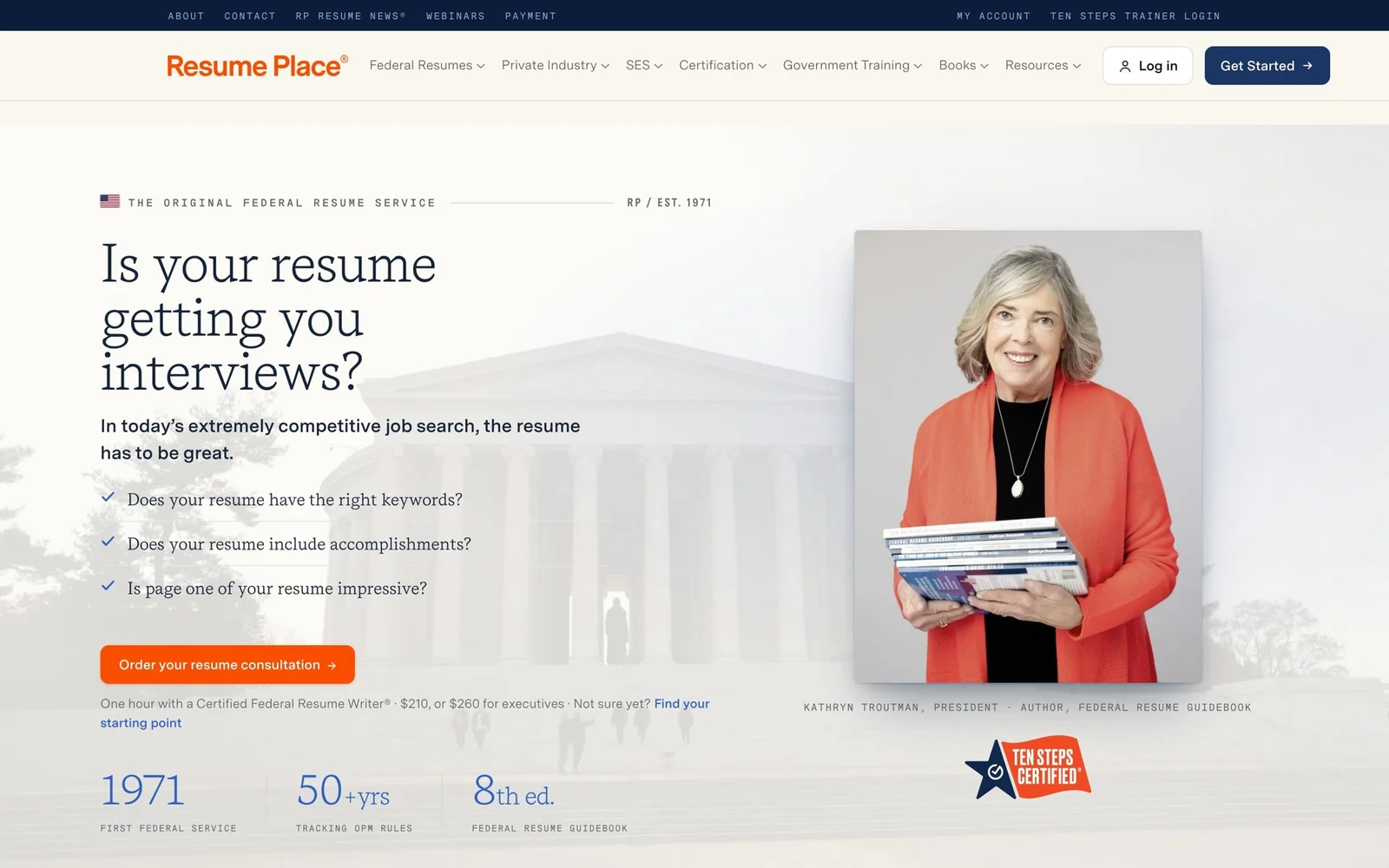
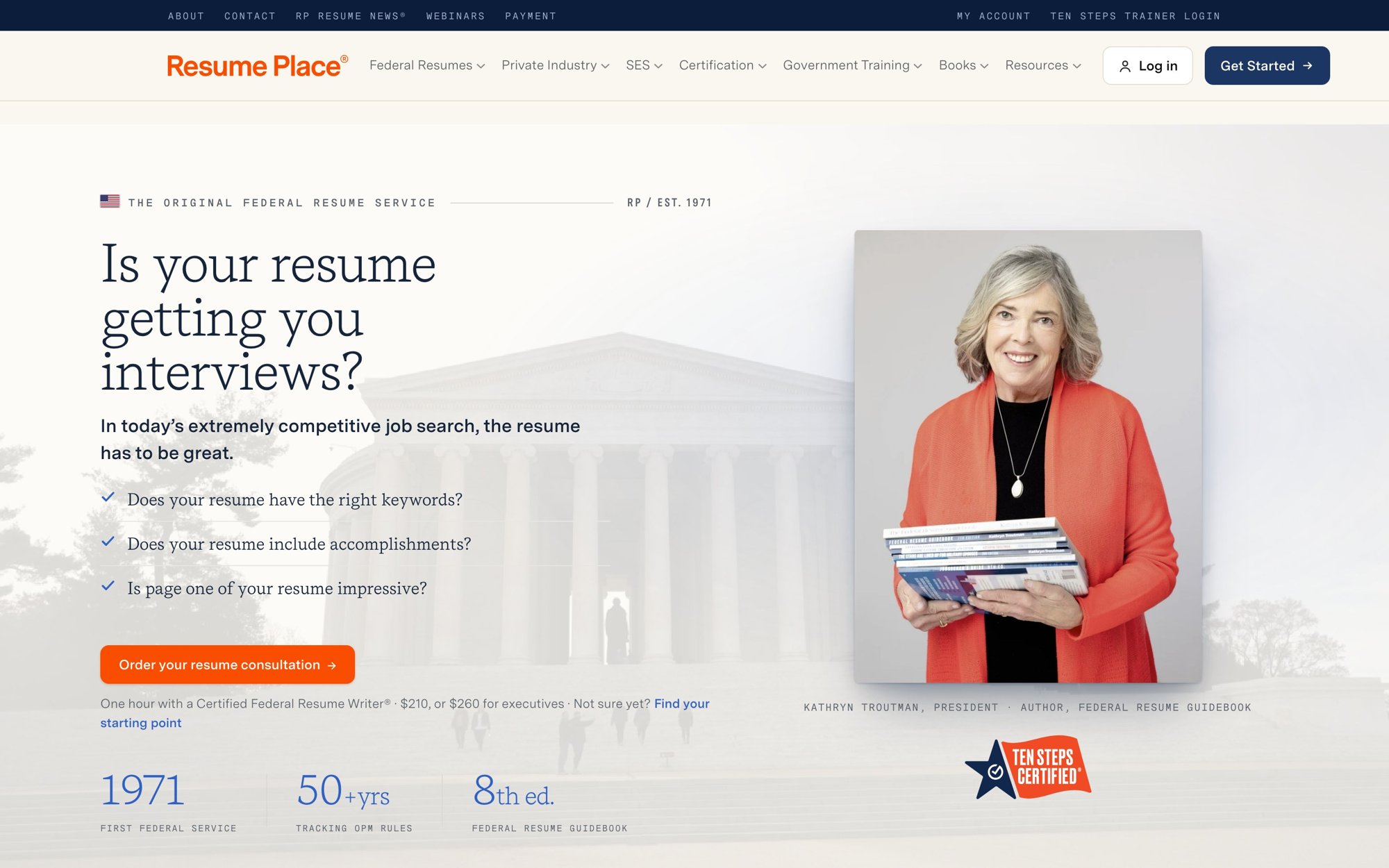
Fifty years of proof, first thing you see.
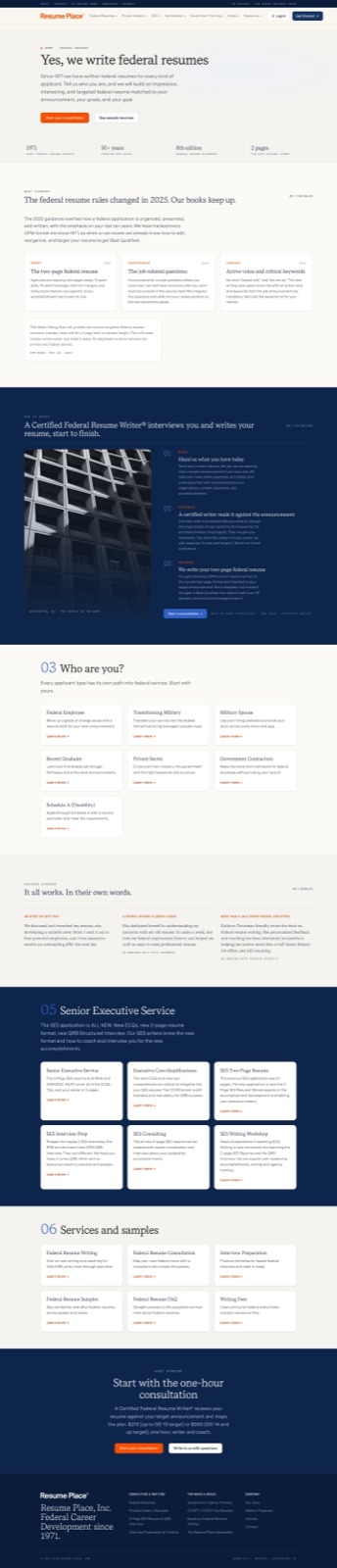
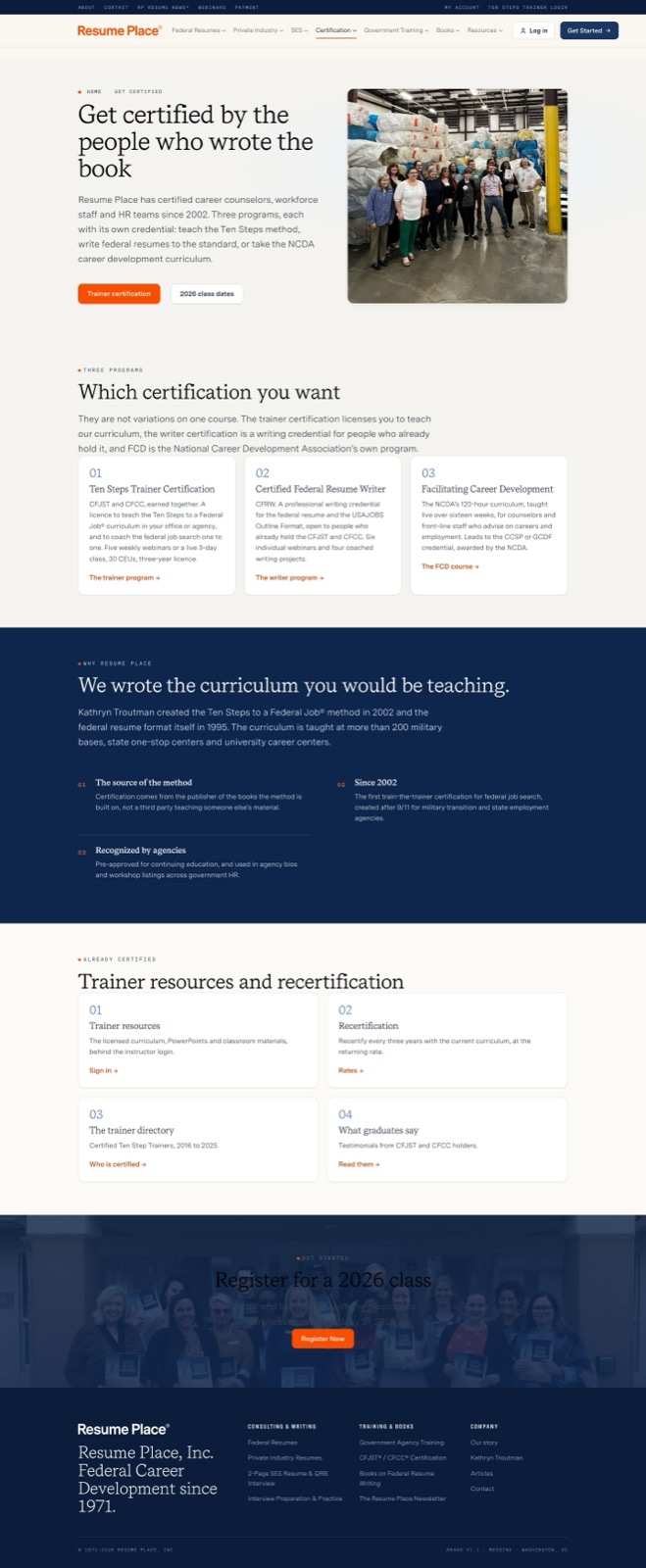
The rebuilt site as it runs: the opening screen that asks the visitor a question, with the proof numbers in serif, one consultation section per page, the navy sections explaining the method, and the book shelf. Navy is the background; tangelo appears once per page. Full pages, scroll inside the windows.


The Resume Place helps people write new chapters in their story of service and commitment to America.
Cut from the full case study at wrkhrs.co/work/resume-place